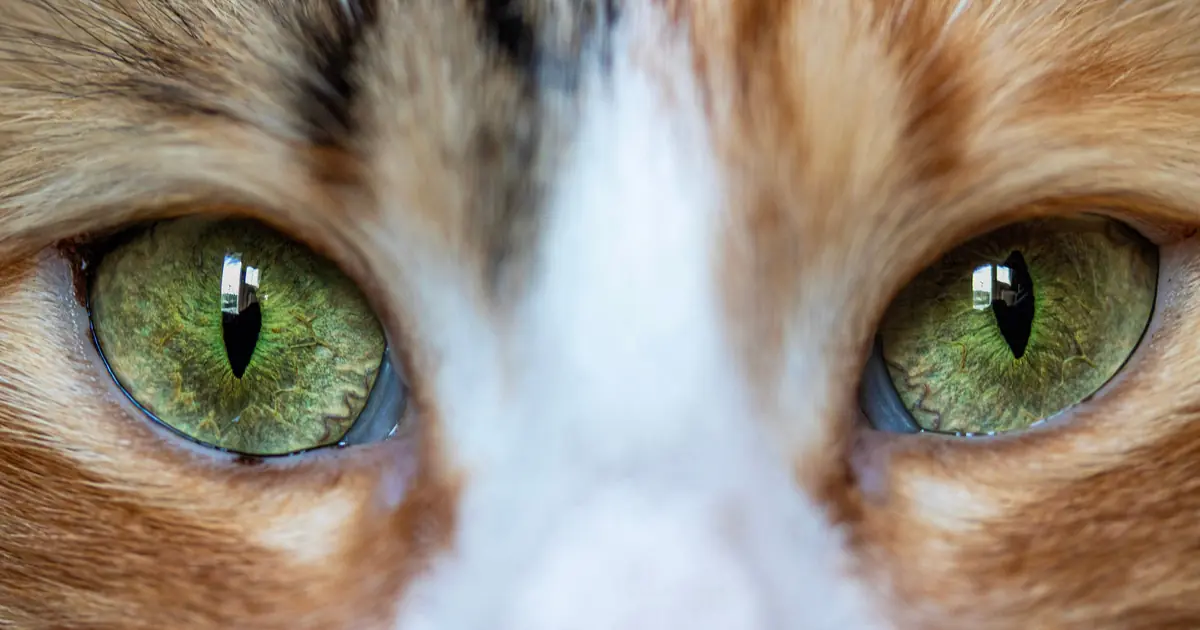
Look closely at your cat’s eyes the next time she’s crouched by a toy mouse, and you’ll see it: that narrow, black slash of a pupil that looks almost reptilian. It’s a little unsettling if you think about it too hard. Cute, fuzzy housecat, snake-like eyes.
There’s nothing spooky going on, though. That slit shape is one of the neatest pieces of evolutionary engineering in the animal kingdom, and it tells you a lot about how your cat’s ancestors survived long before anyone was filling a food bowl for them.
- Cats have vertical slit pupils because they evolved as small, low-to-the-ground ambush predators, not chasing hunters like lions or wolves.
- A 2015 study by vision scientists at UC Berkeley and Durham University, published in Science Advances, found vertical-slit pupils are strongly linked to ambush predators active both day and night, and especially common in species shorter than about 16.5 inches at the shoulder.
- A cat’s pupil can change area by a factor of about 135, from a thin vertical line to a nearly full circle, compared to only about 15 times for the round human pupil.
- Big cats like lions and tigers have round pupils, not slits, because they’re tall, chase prey over distance, and hunt differently than a house cat stalking a mouse.
- Vertical-slit pupils sharpen a cat’s depth perception for judging exactly how far to pounce, which matters when you’re small and only get one shot at a meal.
Why do cats have slit “snake eyes”?
Cats have vertical slit pupils because their whole hunting style is built around ambush, not the chase. A domestic cat is a small predator that needs to get very close to prey (a mouse, a bird, a bug on the windowsill) before it strikes. That means a cat’s eyes had to evolve for two jobs at once: seeing well in both bright daylight and near darkness, and nailing the exact distance to a target before a pounce. A round pupil is a decent all-purpose design. A vertical slit is a specialist’s tool, and cats are specialists.
Think of your cat’s slit pupil as a built-in aperture ring, the same idea a camera lens uses. Muscles around the eye squeeze the pupil into a hair-thin line in bright light and let it balloon out into a near-perfect circle in the dark. Few other everyday shapes can stretch that far without losing focus, and that flexibility is exactly what a stalk-and-pounce hunter needs.
What do vertical-slit pupils actually do for a cat’s vision?
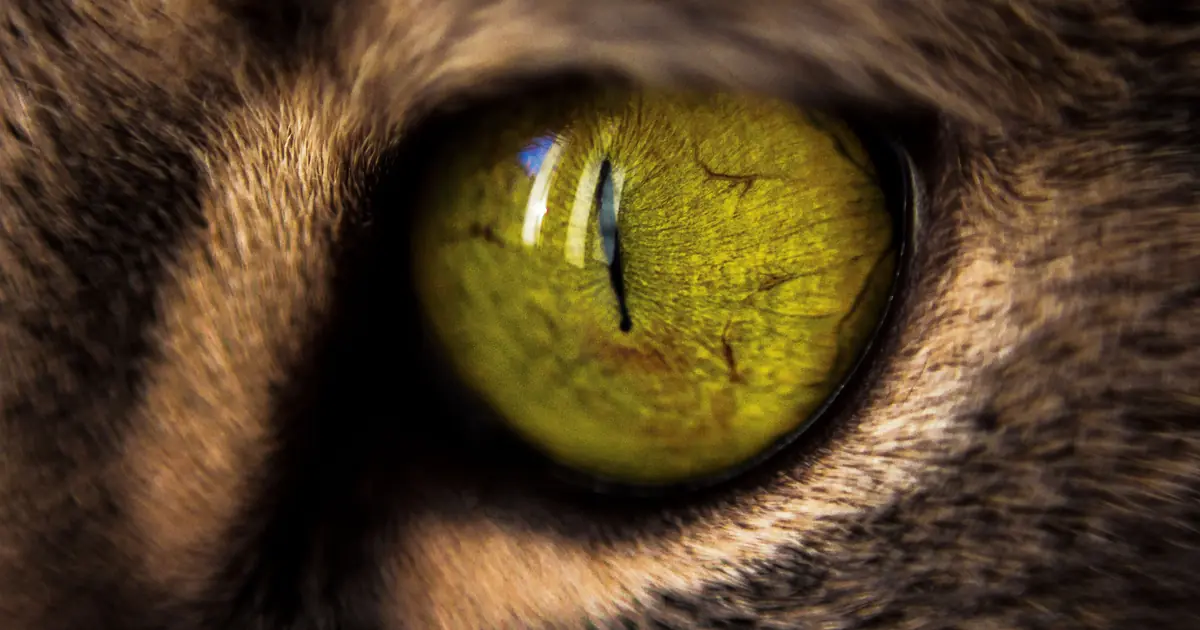
Vertical-slit pupils give cats an enormous range of light control and sharper depth perception for judging a pounce. A cat’s pupil can change in area by roughly 135 times between fully open and fully closed, compared to about 15 times for the round pupil in a human eye, according to VCA Animal Hospitals. That huge swing is why a cat can go from squinting in noon sun to seeing clearly in a barely-lit room without missing a beat.
The slit shape also helps with something more subtle: figuring out exactly how far away something is. Researchers who study depth perception point to two main visual cues an eye uses to judge distance: stereopsis (comparing the slightly different images from each eye) and blur (how out-of-focus something looks at different distances). A vertical slit pupil happens to maximize both of these cues for objects that are close and low to the ground, which is precisely where a mouse or a moth usually is. A round pupil is better at judging distance across a wide field of view, which suits an animal chasing prey over open ground rather than crouching and waiting for it to wander close.
What did the 2015 study on pupil shape actually find?
A 2015 study by vision scientists at UC Berkeley and Durham University found that an animal’s pupil shape closely tracks its hunting style and how tall it stands, not what species it belongs to. The researchers, led by Berkeley optometry professor Martin Banks, examined 214 species of land animals and published their findings in the journal Science Advances. Among 65 predator species with forward-facing eyes, 44 had vertical-slit pupils, and 82 percent of those were shorter than about 16.5 inches (42 cm) at the shoulder, exactly the ambush-hunter profile a house cat fits.
The UC Berkeley research team summed it up simply: vertical slits show up again and again in small, ground-hugging ambush predators that are active around the clock. Taller predators that actively chase prey across open terrain, like wolves, tend to have round pupils instead. Grazing prey animals like sheep and goats have horizontal pupils, which help them scan the horizon for danger while keeping their heads down to eat. Pupil shape, in other words, is basically a résumé for how an animal survives.
Why do cats’ pupils change shape and size?
A cat’s pupils shrink to slim slits in bright light and stretch into wide circles in dim light or when your cat is excited, scared, or fully focused on something. That’s the same slit-shaped pupil doing its light-control job, just at different points along its range. Fear, play, and a sudden noise can all trigger extra-round pupils too, since a rush of adrenaline dilates them regardless of how bright the room is.
This article is about the shape of a cat’s pupil (why it’s a vertical line at all). If you want the full story on what it means when your cat’s pupils suddenly go huge and round, including the mood and lighting cues involved, our guide on why cats’ pupils get big covers that piece in detail.
Do big cats like lions and tigers have slit pupils too?
No, most big cats have round pupils, not vertical slits. Lions, tigers, jaguars, and other large cats stand much taller at the shoulder and hunt by actively chasing prey across open ground rather than lying in ambush close to the target. That taller, more active hunting style favors a round pupil, which gives a wider field of sharp focus at varying distances instead of the close-range precision a slit provides. It’s a helpful reminder that pupil shape follows lifestyle and body size, not just “cat” as a species. Smaller wild cats that hunt more like house cats, such as bobcats and servals, do share that vertical-slit design.
Are slit pupils related to a cat’s night vision?
Yes, a cat’s slit pupils are part of the same toolkit that makes cats such good night hunters. Cats can open their vertical pupils dramatically wider than a round human pupil ever could, letting far more available light reach the retina after dark. Pair that with a reflective layer behind the retina called the tapetum lucidum, which bounces light back through the eye for a second pass, and you get a hunter built to work the low-light hours around dawn and dusk when a lot of small prey animals are active. For more on how far this ability actually goes, see our breakdown of whether cats can see in complete darkness (spoiler: not in total blackness, but close).
Why do cats and snakes have such similar-looking eyes?
Cats and snakes share vertical-slit pupils because they both evolved as low, ambush-style predators, not because they’re related in any way. Biologists call this convergent evolution: two very different animals independently landing on the same solution because they face the same survival problem. A pit viper waiting motionless for a rodent to pass by has almost nothing in common with your cat curled under the couch, except that both need pinpoint distance judgment at close range and both hunt in a mix of daylight and darkness. Evolution just kept reaching for the same tool.
Pupil shape compared across animals
| Pupil shape | Typical animal type | Why this shape helps |
|---|---|---|
| Vertical slit | Small ambush predators active day and night (house cats, foxes, some snakes) | Huge light-control range and sharp depth perception for judging a close pounce |
| Horizontal | Grazing prey animals (sheep, goats, horses, deer) | Wide panoramic view to scan for predators while the head is lowered to graze |
| Round | Tall, active-chase predators (lions, tigers, wolves) and humans | Consistent sharp focus across a wide field for tracking moving prey over distance |
What color are a cat’s eyes, and does eye color affect the pupil?
A cat’s eye color, whether green, gold, blue, or copper, comes from pigment in the iris and has nothing to do with pupil shape. Every cat, regardless of eye color, still has that same vertical-slit pupil sitting in the center. If you’re curious about the range of shades cats can have and what causes them, our guide to what eye colors cats can have walks through the genetics, and our piece on cats with orange eyes looks at that specific shade. Cats who prefer dim corners of the house for napping also tend to make good use of that wide pupil range; see our post on why cats like the dark for more on that habit.
Frequently Asked Questions
Q: Why do cats have vertical pupils instead of round ones?
Cats have vertical pupils because they evolved as small ambush predators that hunt close to the ground. A 2015 UC Berkeley and Durham University study found this pupil shape shows up mainly in shorter predators (under about 16.5 inches at the shoulder) that stalk and pounce rather than chase.
Q: Do all cats have slit pupils?
Most small and medium-sized cats, including domestic cats, bobcats, and servals, have vertical-slit pupils. Big cats like lions, tigers, and jaguars have round pupils instead, since their larger size and chase-style hunting favor a different eye design.
Q: Why don’t lions have slit pupils like house cats?
Lions have round pupils because they’re tall and hunt by actively chasing prey across open terrain, rather than ambushing from close range. Round pupils give a wider field of sharp focus useful for tracking a moving target over distance.
Q: How much can a cat’s pupil actually change size?
A cat’s pupil can change in area by roughly 135 times, from a thin vertical slit to a nearly full circle. That’s a much bigger range than the human eye, whose round pupil only changes by about 15 times.
Q: Do slit pupils help cats see in the dark?
Yes, a cat’s slit pupils can open far wider than a round pupil, letting in much more light after dark. Combined with a reflective layer behind the retina called the tapetum lucidum, this gives cats strong vision in dim conditions like dawn and dusk.
Q: Is it true that snakes have similar eyes to cats?
Yes, many snakes, especially pit vipers, have vertical-slit pupils for the same reason cats do: both evolved as ambush hunters needing precise close-range distance judgment. Scientists call this pattern convergent evolution, since cats and snakes aren’t related but arrived at the same eye design.
Q: What does it mean if my cat’s pupils are big and round all the time?
Wide, round pupils in a cat usually mean low light, excitement, fear, or intense focus rather than anything wrong with the eye’s shape itself. If your cat’s pupils stay unusually dilated in normal bright light or look uneven between the two eyes, it’s worth a call to your vet to rule out a medical cause.
Q: Does a cat’s eye color affect its pupil shape?
No, eye color and pupil shape are completely separate traits. A cat with green, gold, blue, or copper eyes still has the same vertical-slit pupil, since eye color comes from iris pigment and pupil shape comes from the muscles that control the eye’s opening.
This article is for general education about feline eye anatomy. If you notice sudden changes in your cat’s pupils, uneven pupil size between the two eyes, or any sign of eye pain or vision loss, contact your veterinarian promptly.

Hello and welcome to The Ideal Cat!
We are some passionate cat owners from different professions. We love our cats and have a lot of experience in how to care for our pets. We are incredibly excited to share our knowledge, experience, and research with you. So you can take good care of your loving cat. We will answer most of the common questions about owning cats, taking care of them, etc. If you have any question contact with us. Thanks for visiting! Enjoy the content.
